

Westmorland and Furness Council
Harnessing service design

How Westmorland and Furness Council's Digital and Family Help Teams found clarity and reduced operational pressure through collaborative service design.
Westmorland and Furness Council has the ambitious goal of introducing family hubs across the region, providing a Family Help Service. The service offers practical and emotional support to families, including individuals leaving care services, via a range of physical and digital services.
At the start of the project, just one family hub was operational (in Barrow Library), offering a range of services on-site and in additional local settings. An existing website offered some relevant services to families, but there was no overall integration between the physical and digital offerings.

Leveraging technology to enhance service provision

The Family Help Team wanted to expand and develop its digital roadmap for the Family Help Service across the region. The digital ambition is to help leverage technology to enhance the accessibility, efficiency and effectiveness of support offered, providing families with services even where no physical hubs yet exist.
Westmorland and Furness Council had recently disaggregated from Cumbria County Council, creating significant operational pressures. The Family Help Team, responsible for crucial community support services, needed assistance from the Digital Innovation Team as part of their transformation strategy.
Without a clear roadmap, the Family Help Team’s requests of the Digital Team risked being scattergun and uncoordinated, putting pressure on the Digital Team and potentially lowering the quality of the end result.
A key challenge was that virtual hubs would struggle to meet the unique needs of different localities effectively. The council sought external expertise to envision, crystallise, and prioritise what was needed and to produce a digital roadmap, including an options paper, and assigned the work to Scott Logic.
Scott Logic’s collaborative approach helped us unify our thinking and clearly see the path forward. They brought everyone to the table and gave us the clarity we needed.
Helen Blake, Assistant Director of Customer and Digital, Westmorland and Furness Council
Building clarity through collaboration
To design the roadmap, Scott Logic facilitated close collaboration between teams across the council.
We began by thoroughly examining the operational successes and challenges of the Barrow family hub. Leveraging a structured service design methodology, we facilitated extensive workshops and roundtable discussions involving both the family and digital teams.
Crucially, they included specialist content editors and designers to ensure proposed digital solutions were intuitive, accessible, and flexible. Through collaborative mapping and open dialogue, stakeholders gained a clear view of their current service ecosystem. This helped to identify areas for prioritisation and collaboration between the Digital Team and the Family Help Team.
Creating adaptable virtual hubs

Using insights gathered from the Barrow hub, Scott Logic designed a blueprint for virtual family hubs that provided consistency while allowing flexibility to address specific local needs. Their user-centred approach ensured these hubs could effectively mirror the success of Barrow’s physical location, while digitally accommodating the nuanced requirements of each community area.
Scott Logic’s service design approach, coupled with the content expertise in the Digital Team, addressed concerns and managed expectations of stakeholders and the project team.
Virtual hubs were shown to be viable and practical solutions, and the way of working and outcomes meant that the council also achieved alignment across both teams, with everyone pulling in the same direction and aware of the wider context of the work they were doing.
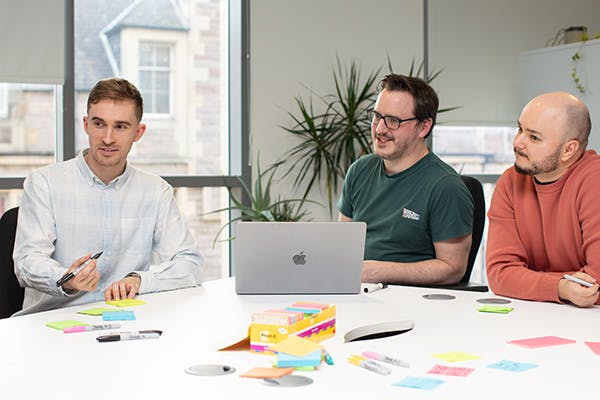
Scott Logic’s facilitation skills were critical for success. Working closely with one team of content designers and editors also played an essential role in crafting a clear set of recommendations for effective digital services that communities could intuitively use and understand, which would significantly reduce the demand on the digital team for ongoing support.
Improved cohesion, reduced pressure
The service design project delivered clarity, alignment, and practical outcomes that promise to transform the operational effectiveness of both public-facing services, and the way the Family Help and Digital Teams work together. The Family Help Team achieved clearer workflows and a cohesive operational focus, dramatically reducing their need for ad-hoc digital support. This allowed the Digital Team to shift from reactive support roles into strategic delivery.
Additionally, the flexible and scalable virtual hub model provided the council with a clear pathway to expanding their family service provision while they made longer-term plans to build more physical hubs. Now confident in the approach, Westmorland and Furness Council can efficiently replicate services across communities by working collaboratively and smartly using internal resources.
Looking forward
With Scott Logic’s collaborative, user-focused approach, Westmorland and Furness Council has a plan to transform its service delivery. They now enjoy streamlined operations, clearer communications, and a sustainable roadmap for future digital and physical expansion, ready to adapt swiftly to future challenges.

Get in touch
Want to know more about how we could support your organisation?
Drop us a line to find out how our approach could help.