

Scopevisio
From migration risk to AI-accelerated delivery

Executive Summary

The challenge
To modernise a complex ERP application while minimising the risk that migration changes could affect a live production system.

What we delivered
An AI-enabled delivery approach, bespoke testing capability and repeatable workflows that made migration safer, faster and easier to sustain.

Duration
12 weeks

The outcomes
Increased backend delivery velocity by 3x per developer and team throughput by 7x, creating a viable, scalable path to migration.
Key results

The full story
Scopevisio set out to modernise a complex application, but the scale and risk of migration had made progress difficult to sustain. By transforming the software delivery lifecycle around AI and introducing new approaches to testing, requirements and delivery, we helped the team unlock a viable, repeatable path to migration.
Scopevisio is a leading provider of Enterprise Resource Planning (ERP) software that simplifies and automates business processes for medium-sized organisations. The company needed to modernise a complex, long-standing desktop ERP application by migrating to a new web-based product. The ambition was clear: create a platform that would be easier to update, scale and evolve, giving the business a faster route to modernisation. However, the migration carried significant risk. The existing and new applications shared the same backend, meaning every change had the potential to affect the live system.
Scott Logic was brought in to help Scopevisio use agentic AI to overcome this delivery challenge by following our Agentic Engineering Enablement approach. Rather than simply accelerating coding, we helped redesign the software development lifecycle around test safety, requirements flow and repeatable AI-enabled workflows. This gave Scopevisio a safer, faster path through a previously constrained migration, with a 3x increase in delivery velocity.
Scott Logic brought the professionalism, leadership and technical calibre we needed to move a highly ambitious programme forward. The goals we set were challenging, and at the start there was real uncertainty about how we would achieve them, but the team delivered on every single one.
Dr. Lukas Pustina, CTO, Scopevisio
Assessing the lifecycle and laying new foundations


The Assess phase of Agentic Engineering Enablement looks across the whole software development lifecycle to understand where AI could create value, and where existing constraints would prevent that value being realised. Through workshops with the Scopevisio team, it became clear that testing and requirements gathering were the main bottlenecks impeding progress, not coding itself.
Indeed, accelerating development without tackling those constraints would make the situation worse. At the end of this rapid and intensive phase, it was clear that by building test capability and improving the flow of requirements, the team could begin progressing at pace.
The Foundation phase explored how to make this progress possible. Our small team of engineers integrated with the Scopevisio team from day one to build in-house capability by working together on the challenge, using tools from Anthropic’s Claude ecosystem, such as Claude Code and Claude Design.
The long-standing nature of the existing system meant that it was partially undocumented, so the team used Claude’s AI agents to form a shared understanding of the system and reassess the planned architecture and migration approach. AI agents also enabled the team to explore different test strategies and ways of breaking the system down into testable units. From there, the team used AI to prototype early versions of a bespoke testing tool, creating the safety net needed to unlock the migration.
Making acceleration feasible and safe

Building on the four-week Foundation phase, the Accelerate phase focused on developing the custom testing tool to the point where the team could confidently integrate new code into the live application. Without agentic AI, building this tool would have been so complex and expensive that it would likely have been dismissed up front.
With this capability in place, the team could build large portions of the tool, test and refine ideas quickly, and explore multiple technical approaches in parallel. AI made the cost of experimentation low, and allowed decisions to be made based on evidence, not assumptions.
This fast, iterative period of AI-augmented development culminated in the moment it was safe to merge new features into the live codebase. The turning point came when the team could safely merge new features into the live codebase. From that moment, the migration stopped being a high-risk leap and became an incremental delivery challenge.
Making work repeatable and scalable


With this fundamental blocker removed, the team’s attention could turn to the challenge of improving the flow of requirements – and the results were, again, transformative. Using AI agents, the team could treat the existing system as the primary source of truth, mining it for behaviours and flows, and inferring any missing requirements.
For each new feature, they could generate a usable starting point without having to wait for up-front clarity. In the meantime, the role of Scopevisio’s Business Analysts and Product experts shifted from gathering and defining requirements to reviewing, refining and validating them.
Crucially, the team made the requirements gathering process repeatable by creating what it called ‘workflows’ – structured ways of working that ensured consistency and reduced rework.
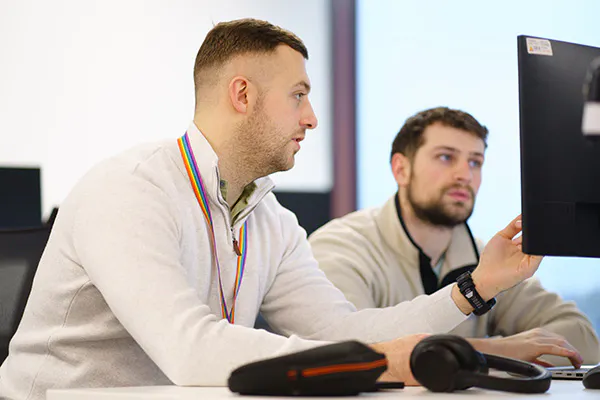
In the case of requirements gathering, the workflow was a series of steps guiding the AI agents to collect inputs from meeting transcripts, documentation and the codebase, and turn them into consistent specifications for validation by human experts. In this way, requirements gathering kept ahead of the pace of development so that the migration’s accelerated progress could be sustained.
Workflows like this underpinned the transformation. During each phase, the team defined and refined repeatable ways of working, including elements of ‘harness engineering’, where the surrounding context, tools and instructions are structured so that AI can operate effectively.
Workflows are analogous to the ways agile teams have long sought to make delivery more predictable. However, while agile optimises for how people work, workflows are designed around the strengths and limitations of AI; they must be defined, tested and refined much more quickly, so that the team can sustain a higher delivery speed without losing control.
The workflows were not fixed templates. Instead, they evolved as the team identified what each task required and how best to use AI to deliver it efficiently. Working together, it was a new mindset that developed within the team – one which Scopevisio could apply to the rest of the migration and beyond.
Transforming software engineering at Scopevisio
During the engagement, backend delivery velocity increased by 3x per developer, while throughput at a team level increased by 7x. This was not simply the result of AI-assisted coding; it was the result of redesigning the software development lifecycle to make the best use of the AI agents and the human experts guiding them.
These gains were underpinned by investing around 70% of backend capacity in core foundations, including codified skills, the test safety net and the requirements workflow. Every future feature that reused these foundations inherited the gain.
The most important outcome was that, thanks to agentic-enhanced development, a project that faced a potentially insurmountable hurdle became achievable. Through Scott Logic’s support to rethink the software delivery lifecycle, Scopevisio could take a different route forward.
Complex migrations no longer need to stall, and the cost and risk barriers that once stood in the way can be significantly reduced. For organisations facing similar challenges, the question is no longer whether transformation is possible, but whether they are ready to approach it differently.

Ready to accelerate software delivery with AI?
Get in touch to book a two-day Assess workshop